The Hidden Tax on Every Status Report
Your team spends its weeks writing reports and sitting in status meetings — and somehow understands the project less, not more. That is not a discipline problem. It is a team-cognition problem, and decades of research points to the fix.
It is Thursday afternoon. Three people on the team are not building anything. They are writing about building things — assembling the weekly status report. Tomorrow morning, eight people will sit in a forty-minute meeting where most of that report is read aloud to people who could have read it themselves.
Everyone agrees this is necessary. Everyone also quietly suspects it is not working. The project does not feel more understood after the meeting. The same questions resurface next week. The risk that bites you is never the one on the slide.
Here is the uncomfortable part: the reports and the meetings are not just a waste of time. Past a certain point, they actively weaken the thing they are supposed to build — your team’s shared understanding of the work. There is a name for that shared understanding, there is research on why it erodes, and there is a better container for it than a slide deck.
The Hidden Cost of Coordination
Start with a finding that sounds obvious but changes everything once you take it seriously. In 2004, a group of human-factors researchers studying military command teams put a name to it: communication overhead — the hidden cost of team cognition (MacMillan, Entin & Serfaty).
Their point was this. A team has to act as a single information-processing unit. To do that, members must keep exchanging information so that everyone holds a shared picture of the situation. But that exchange is not free. It costs time, and it costs cognitive bandwidth — the same finite attention people need to actually do the work. Their conclusion, stated plainly: to the extent that communication can be made less necessary or more efficient, team performance improves.
Read that again, because it inverts the usual instinct. When a project feels confused, the reflex is to add communication — another report, another stand-up, another sync. But communication is the cost, not the cure. Adding more of it to fix confusion is like turning up the heating to fix a draught: you are paying more to treat a symptom while the hole stays open.
Plain version:
- The goal is a team that shares a picture of the work clearly enough that it rarely needs to stop and re-explain it.
- A meeting is what you spend to build that picture.
- A status report culture gone wrong is a team that spends so much on the explaining that it never has the picture — only an endless stream of explanations.
What Your Team Is Actually Trying to Share
So what is this shared picture? Two ideas from organisational psychology pin it down, and they are the heart of this post.
The first is the shared mental model. The most-cited study in the field (Mathieu and colleagues, 2000) showed that when teammates hold convergent mental models — of the task, and of how the team works — they coordinate better and perform better. Crucially, the effect runs through coordination. Shared understanding does not improve results by magic; it improves results by letting people anticipate each other instead of constantly checking in. A later study (Van den Bossche and colleagues, 2010) showed how these models actually get built: not by broadcasting updates, but through co-construction and constructive conflict — people working a problem together until they genuinely converge.
The second idea is the transactive memory system — a slightly awkward term for something you already know. It is the team’s shared answer to “who knows what.” On a healthy team, nobody holds everything, but everybody knows where the knowledge lives: Priya owns the payments integration, Tom remembers why the migration was deferred, the deployment quirks live with the platform group. Transactive memory is the index over the team’s collective expertise, and it reliably predicts team performance — recently demonstrated in settings as high-stakes as hospital trauma teams (Argote and colleagues, 2025), where there is no time to re-explain anything and the team simply has to know who does what.
Now look at what bloated reporting does to both.
A shared mental model is built by working a problem together. A status meeting where one person reads updates to seven others is the opposite of co-construction — it is broadcast, not convergence. And a transactive memory system depends on people knowing where knowledge lives; but when knowledge only ever surfaces as last week’s status line, it stays locked in individual heads and walks out of the door when someone changes team. The reporting machine consumes the very hours that genuine shared understanding would have been built in.
This Is a Very Old PMO Problem
If you have spent time in a project management office, none of this is new — you have just never had a name for it.
The classic PMO failure mode is maturity without automation. The office is asked to add governance: more oversight, more assurance, more reporting lines. Each layer is reasonable on its own. But every layer is paid for in the same currency — people writing things down and people sitting in rooms. The result is the pattern every PMO veteran recognises: more reporting, more meetings, more spreadsheets, same headcount. The office grows busier and the projects grow no clearer.
This is the communication-overhead tax, dressed in corporate clothing. The PMO was created to give the organisation a shared, reliable picture of its projects. But when it can only produce that picture by manually aggregating status — analysts copying numbers into decks, chasing updates, reconciling spreadsheets — it spends all its bandwidth on the exchange and has none left for the understanding. The administrative burden is not a side effect of doing PMO work. It is what happens when team cognition has no container except documents and meetings.
So the real question is not “how do we run better meetings?” It is: is there a better place to keep a team’s shared understanding than in reports and people’s heads?
Why Meetings Cannot Carry the Most Important Thing
Before the answer, one more piece of research — the one that explains why even good meetings leak.
What is the genuinely valuable thing exchanged in a strong decision meeting? It is not status. Status is just data. The valuable thing is calibrated judgement: not only “the launch date is at risk,” but “I am about 80% confident it slips, and here is what that confidence rests on.”
Cognitive scientists have a precise account of why this matters. Shea and colleagues (2014) argue that the human ability to explicitly represent and broadcast our own confidence — to say out loud “I’m sure” or “I’m doubtful” — evolved for exactly one purpose: coordinating the thinking of two or more people on a shared task. They call it supra-personal cognitive control. The whole function of saying how confident you are is so the group can decide what to do with your input — and the research shows joint decisions get measurably better when people share calibrated confidence and give more weight to the better-calibrated voice (not merely the loudest or most senior one).
Here is the catch. In a meeting, this calibrated judgement is exchanged once, out loud, and then it evaporates. It is not written down in any inspectable form. Nobody can later ask “what was that estimate based on?” or “were we well-calibrated last quarter?” The most valuable cognitive output your team produces — its reasoning, with its uncertainty attached — has no durable home. It is spoken into the air and lost. So you hold another meeting to reconstruct it, and pay the tax again.
Cognition as Code: A Better Container
This is where turning decision logic into code stops being a technical preference and becomes the actual fix. Not because code is clever, but because code is a far better container for team cognition than documents and meetings are. Map it back to the three ideas:
A shared mental model that everyone can see. When the way your team forecasts a schedule, or compares two options, or reads a project’s health is written as an open, executable function — a Monte Carlo simulation, a Total Cost of Ownership model, an Earned Value calculation — the method is no longer trapped in one expert’s head or re-litigated every meeting. Everyone is looking at the same model, computed the same way. The shared mental model becomes a thing you can point at, not a thing you hope has converged.
A transactive memory that does not resign. When “auth tasks in this kind of project tend to run 30% over” is encoded as a calibration parameter rather than living in one veteran’s intuition, it stops being knowledge that walks out of the door. The team’s hard-won “who knows what” becomes “the system knows that, and shows its working.” The index over expertise survives turnover.
Metacognition you can inspect. This is the sharpest point. A Monte Carlo forecast does not just give a date — it gives a date with its confidence attached: “85% likely to land by here.” A Bayesian calibration does not just adjust an estimate — it reports how sure it is, tightening only as real data earns it. That is precisely the calibrated, broadcastable confidence that Shea’s research says good group decisions run on — except now it is written down, inspectable, and it persists. You can ask the model what it assumed. You can check, next quarter, whether it was well-calibrated. The most valuable cognitive output of the team finally has a durable home, and it compounds instead of evaporating.
And this is where the AI layer earns its place. The job nobody should be doing by hand — aggregating status, computing the metrics, surfacing where the genuine uncertainty sits — is exactly the job a well-designed agent does continuously and cheaply. Not to replace the human conversation, but to carry the overhead so the conversation can be about the decision rather than the data. Recent work on human–machine teams suggests that agents which absorb this coordinating work are associated with higher team productivity. The meeting stops being a data-reading ritual and becomes what it should always have been: the place humans deliberate over a picture the system already assembled.
What This Looks Like in Practice
A mid-sized PMO oversees twelve programmes. The Thursday-Friday ritual costs, conservatively, two full days of analyst time per week plus a packed governance meeting where most of the hour is spent establishing what the numbers even are. The genuine decisions — where to move money, which risk to fund — get the last ten minutes, when everyone is tired.
The shift is not “cancel the meeting.” It is to move the team’s shared picture out of the deck and into computed, inspectable logic. Schedule confidence comes from a simulation that shows its range, not a single optimistic date. Cost comparisons run through an open model anyone can audit. Estimation bias is learned automatically from completed work, not relitigated in a lessons-learned session nobody attends.
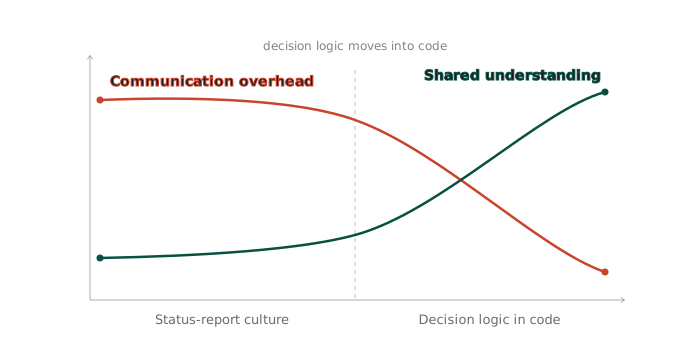
Now the analysts are not transcribers; they are curators of a picture the system keeps current. The governance meeting opens with the shared model already on the screen — same method, same assumptions, confidence attached — and spends its full hour on the part that actually needs human judgement. The communication overhead drops. The shared understanding rises. Those two things move in opposite directions for the first time.
Where the Honesty Lives
Three caveats, because the research is clear about them too.
You cannot codify everything, and you should not try. Tacit, context-rich judgement — reading a stakeholder’s real intent, sensing a team’s morale — resists codification, and forcing it into a form destroys it. The codifiable layer (the maths, the metrics) belongs in code; the genuinely tacit layer belongs with people. The point is to stop spending human bandwidth on the part a machine does better, so there is bandwidth left for the part only humans can do.
Meetings are not the enemy. Co-construction — people working a hard problem until they truly converge — is how shared mental models get built in the first place, and that needs conversation. The target is not zero meetings; it is meetings freed from status-reading so they can do the convergence work that actually requires them.
And shared models can ossify. A team that agrees too completely can stop questioning its own picture. That is why the codified version must stay revisable — why a calibration that updates from real outcomes matters more than one that hardens into received wisdom. A shared model is an asset only as long as it can still be wrong.
Three Things You Can Do Next Quarter
You do not need to deploy anything to start paying less of this tax.
1. Audit what your reporting is actually for. For one reporting cycle, mark each recurring report and meeting as either building shared understanding (people converging on a problem) or transferring status (information moving one way). The second category is pure overhead — and is exactly what should move out of human hands into a computed, always-current view.
2. Find the knowledge that would resign tomorrow. List the five things your team knows that live in exactly one person’s head — the “auth always runs long,” the “that vendor needs chasing.” Each one is a transactive-memory single point of failure, and each is a candidate for encoding as a parameter rather than a memory.
3. Attach confidence to one number that matters. Take your most important forecast and stop reporting it as a single figure. Report it as a range with a confidence level, and write down what that confidence rests on. You have just turned private judgement into the shared, inspectable, calibrated kind the research says good decisions need — and you can check next quarter whether you were right.
What Comes Next
Everything above rests on one move: getting your decision logic out of documents and meetings and into something an agent can compute and surface on demand. But an agent is only useful if it can reach the places your work actually lives — your assistant, your planning tools, your repository.
That connection now has a standard: the Model Context Protocol (MCP). The next post in this series introduces pmo.run’s MCP server — the layer that lets an AI assistant call these decision tools directly, so the shared picture assembles itself wherever you already work. If this post is the why, that one is the how.
This post is part of the pmo.run series on turning project data into decision intelligence. It builds on Cognition as Code: Co-Evolving with AI Agents, which describes the architecture behind the idea. The logic modules are open source at github.com/lemur47/logic.
The research referenced here: the communication-overhead idea is from MacMillan, Entin & Serfaty (2004), Communication overhead: The hidden cost of team cognition; shared mental models from Mathieu et al. (2000) and Van den Bossche et al. (2010); transactive memory in action teams from Argote et al. (2025); and the account of confidence-sharing as the basis of group decisions from Shea et al. (2014), building on Bahrami et al. (2010), “Optimally interacting minds,” Science.