The Layered Mandate: Why PMOs That Only Add Never Subtract
A 16-year longitudinal study names what PMO practitioners already feel: responsibilities accumulate but never retire. An international look at the trap — and the subtraction mechanism most PMOs lack.
The Daily Reality
Most PMO leaders carry a weekly routine that reveals the shape of their job without anyone having to describe it. The status report template from 2019 is still in use, lightly refactored. The new portfolio dashboard launched last quarter runs alongside it rather than in its place. A recent AI governance committee has asked for a monthly briefing paper. The lessons-learned database is maintained but rarely consulted. Project charters are audited for compliance with a methodology that was officially declared “lightweight” two years ago. None of this is individually unreasonable. Collectively, it is the condition every PMO practitioner recognises: responsibilities arrive but do not leave.
The London summit of UK emergency-service PMOs last November captured this observation in a single remark: “people see you as what you were five years ago.”1 The speaker was describing a strategic role won through years of effort, visibly recognised, and still fragile to the next reorganisation. This is not a UK or public-sector phenomenon. It appears in European asset management,2 in Japanese SIer practices, and in the quiet frustrations of PMO heads wherever projects are many and sponsors are few.
There is a name for the pattern.
The Layered Mandate
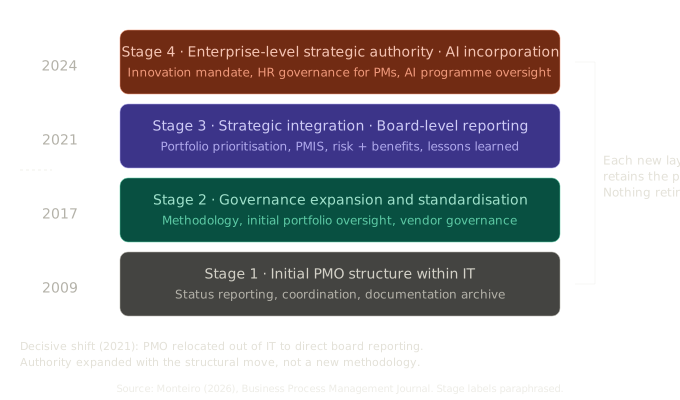
In a 16-year longitudinal study of a large European asset-management firm, António Monteiro documents what he calls the layered mandate: a PMO whose authority grows by accumulation, not by substitution.2 Over four distinct stages — from an IT support unit in 2009, to an enterprise governance body reporting to the board by 2021, and on to the locus of AI and innovation governance by 2024 — functions were retained as new layers were added. Nothing was retired. Every governance capability the PMO acquired was stacked on top of the operational ones it already held.
The study is explicit about its limits. It is a single case. It does not attempt to generalise across industries or geographies, and it notes, unusually, that project-level performance data was not examined. Our reading here is therefore not “this is how PMOs evolve” but rather “this is the phenomenon that, once named, practitioners immediately recognise.” The layered mandate is not a prescription. It is a diagnostic.
The most decisive moment in Monteiro’s account is 2021, when the PMO was relocated from the IT department to direct board reporting. Authority expanded because the organisational position changed, not because the PMO added another methodology. This detail matters. It suggests that the ceiling many PMOs feel — the one that keeps them perceived as “project police” regardless of their actual work — is structural before it is functional. But most PMOs never reach that 2021 moment. They stall earlier, at the layered stage where governance has been formally added but admin burden has not been formally subtracted. That stall is where the international PMO community spends most of its working life, and it has a specific cost.
Where PMOs Stall
The stall is most visible between Stages 2 and 3 — between “we have standardised methodology and portfolio oversight” and “we report to the board and influence the portfolio we oversee.” In Monteiro’s case, the PMO crossed that threshold in 2021, when it was moved out of IT to a direct reporting line with senior management. Authority expanded with the position change. Most PMOs do not get the position change.
The reasons are not mysterious. The UK summit ranked them candidly.1 Insufficient executive sponsorship was the single most-cited challenge. The PMO being perceived as administrative support rather than strategic partner was second. An “everything is priority” culture — where nothing can be declined because no one has the authority to decline — was another recurring theme. The pattern is consistent: without a sponsor who will take decisions, the PMO is asked to enforce prioritisation while being denied the authority to do it. One summit participant observed that losing a supportive executive sponsor “can collapse support overnight.” Another noted the first-to-cut syndrome: a PMO without a vocal advocate at the top is the function that gets reduced when budgets tighten, regardless of how much it prevents downstream cost.
The layered mandate makes this stall mechanically unavoidable. Functions accumulate. Authority does not. The PMO wears more hats without being given permission to take any of the old ones off. Over time, the oldest layers — compliance reports, archive maintenance, standardisation audits — consume the hours that newer strategic responsibilities require. The team grows more reactive, not less. Strategic partnership becomes the slide at the end of the deck that nobody reaches.
The Quantitative Void
The academic literature names the stages. It does not measure the projects within them. Monteiro’s study makes this explicit as a limitation: the work did not systematically analyse project-level metrics such as budget adherence, duration, or the distribution of project successes and failures.2 Across the broader PMO literature, this is the rule rather than the exception. Taxonomies of PMO functions and typologies of PMO authority are well-developed. Instruments that would let a practitioner answer “how predictable is our delivery, and by how much has that improved since last year?” are not.
This matters because the defence of the PMO — especially when under budget pressure — requires exactly that kind of answer. The summit’s advice to demonstrate “value in leader-friendly terms”1 is sound, but it presumes the PMO has the instrumentation to measure itself. Most do not. The spreadsheets that proliferate are symptoms of missing measurement, not solutions to it. Strategic authority, once acquired, holds through evidence. Evidence requires instruments.
Cognition as Code
A rule you cannot write as a function is not a repeatable process. It is a ritual. Rituals cannot be retired, because their correctness depends on the person performing them. A rule written as a function can be retired, replaced, delegated to a queue, or handed to an agent.
This is the subtraction mechanism the layered mandate otherwise lacks. When a PMO encodes its estimating heuristic as a Python function, its portfolio prioritisation as a scoring model, or its benefits tracking as a versioned dataset, the manual practice that used to consume a half-day every fortnight becomes a scheduled job. The governance outcome is preserved. The hours that produced it are recovered and can be redeployed to the next layer. This is how a PMO can add a strategic responsibility without hiring. It is also how a PMO can survive a leadership change: the logic is not in anyone’s head.
The engineering pattern pmo.run uses to express this is open and ordinary.3 Pure mathematical functions at the core, a thin API layer above them, and calibration data tuned to the organisation’s own history. The novelty is not the code. The novelty is treating the PMO’s decision logic as an artefact worth maintaining in source control.
PERT as the On-Ramp
The House of PMO’s Competency Framework describes four practitioner levels: Foundation, Intermediate, Advanced, Expert.4 Each level is associated with breadth of knowledge and the ability to operate independently in progressively more ambiguous contexts. The framework is not prescriptive about which techniques belong to which level. In our experience, the progression of estimation sophistication maps onto these levels cleanly, and gives practitioners a concrete route from one to the next.
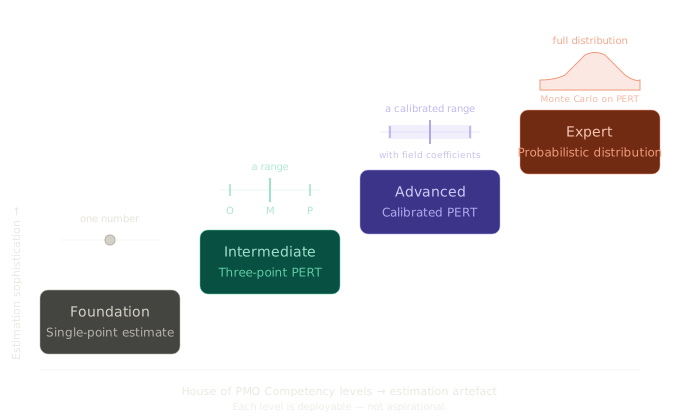
Foundation — single-point estimation. A task will take two weeks. A project will cost £240,000. This is where most organisations begin and many remain. Uncertainty is present but invisible. When estimates miss, the response is individual blame rather than systemic learning. This is also, not coincidentally, the level at which the PMO is perceived as administrative: there is nothing to say except whether the number held.
Intermediate — three-point PERT. The practitioner provides an optimistic, most-likely, and pessimistic estimate, and a weighted average with an explicit standard deviation. Uncertainty becomes part of the vocabulary. Confidence intervals enter portfolio conversations. The PMO begins to be able to say, at sponsor level, “we are 80% confident this finishes before Q3,” which is a different kind of statement from “it will take two weeks.”
Advanced — calibrated PERT. The pessimistic estimate is no longer a hunch. It is informed by coefficients drawn from the organisation’s own delivery history, industry priors, and team composition. The ratio of optimistic to pessimistic outcomes is tracked and audited. Forecasts become reliable enough to influence project selection, not only monitoring. At this level the PMO starts to earn a reputation as a source of better decisions, not just better reports.
Expert — probabilistic distributions. Monte Carlo simulation sits on top of PERT, producing full distributions of schedule and cost rather than three-point summaries. The portfolio can be modelled as a joint distribution; risk-adjusted prioritisation becomes possible. Conversations with sponsors include sentences such as “the 95th-percentile cost of this initiative is above our risk appetite”, which shift the meeting from advocacy to analysis.
Each level is a deliverable, not an aspiration. A PMO at Foundation can introduce three-point estimation on a single pilot portfolio next month. A PMO at Intermediate can begin collecting the delivery data that calibration needs. The ladder is short and concrete, and it connects the work a PMO does day-to-day with the authority it wants to earn.
Stage 4 and Why the PMO Leads
The final layer in Monteiro’s case — Stage 4, from 2024 — is the assumption of formal responsibility for AI and innovation governance. The justification given by the executive sponsor was not aspirational. It was functional: the PMO was the only unit with enough cross-organisational visibility and governance maturity to govern AI adoption at scale.2
This is the correct reading. AI governance needs three substrates: consistent data flow across the portfolio, traceable decision-making with accountability, and a calibration loop that improves over time. A PMO that has encoded its decision logic — its estimation, its prioritisation, its benefits tracking — already has all three. A PMO that has not will need to build them from nothing, in a hurry, under external pressure. The difference between Stage 3 and Stage 4 is, in effect, whether the PMO arrived at the AI conversation with the instruments already in its hand.
For the international PMO community, this is both the most demanding and the most promising layer. It is demanding because the wave of AI adoption is moving faster than most governance functions are built to absorb. It is promising because the function best positioned to govern it responsibly — for transparency, ethics, and business alignment — is the one that already exists.
Subtract as You Add
Every mandate layer the organisation adds to the PMO adds weight. Tooling is the solvent. When a rule becomes code, the manual practice it replaces can be put down. When the hours come back, the next layer can be added without the team growing in proportion. When the PMO has a few years of these substitutions behind it, the strategic seat at the table stops being fragile. It becomes structural, because the PMO is the function that knows, and can demonstrate, how the organisation’s projects actually behave.
The layered mandate is not a trap because layers accumulate. It is a trap only when nothing is retired. The work of the contemporary PMO, in our view, is to build the subtraction mechanism deliberately, one encoded rule at a time, until the institution’s memory is no longer the team’s calendar.
Try It
- PERT estimator (Claude Skill) — three-point estimation with confidence intervals. Paste a task list, get calibrated ranges.
- Monte Carlo schedule simulator (Claude Skill) — probabilistic schedule distributions from PERT inputs.
- Open source — all module maths on GitHub: github.com/lemur47/logic. MIT licensed.
Footnotes
-
House of PMO and AtkinsRéalis, Supporting Change in Blue Light Services: PMO Summit Report, London, November 2025. houseofpmo.com/blue-light-report. ↩ ↩2 ↩3
-
Monteiro, A. (2026). The evolving mandate of project management offices: governance, innovation, and performance, evidence from a longitudinal case study. Business Process Management Journal. DOI: 10.1108/BPMJ-09-2025-1464. ↩ ↩2 ↩3 ↩4
-
pmo.run architecture and module source: github.com/lemur47/logic. ↩
-
House of PMO, PMO Competency Framework. Levels referenced: Foundation, Intermediate, Advanced, Expert. ↩